How Anythink Libraries Built a Multiplayer Metaverse World With Unreal Engine and Pixel Streaming
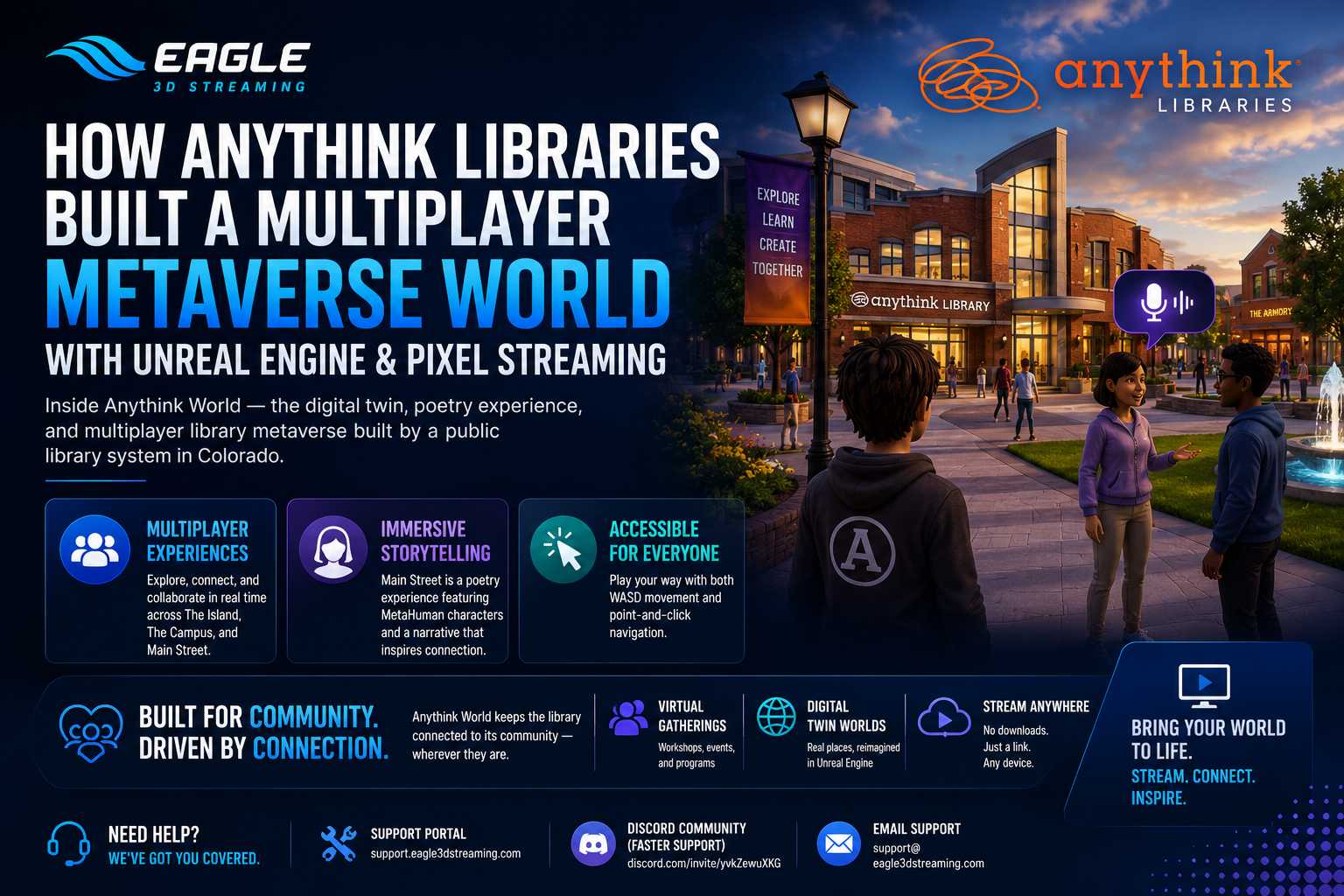
Inside Anythink World — the digital twin, poetry experience, and multiplayer library metaverse built by a public library system in Colorado.
 MD Rafshan Tashin Eshan
January 5, 2026
8 min read
When people think of public libraries, virtual worlds and MetaHuman avatars rarely come to mind. But Anythink Libraries, serving Adams County, Colorado, has spent the past several years building Anythink World — a fully interactive, multiplayer online space designed to keep the library connected to its community, even when its physical doors were closed.
In a recent episode of Real Time Talk with Eagle 3D Streaming, Alex Thao, Anythink World Manager, walked through how the project came together, why multiplayer and voice chat were non-negotiable features, and how Unreal Engine and pixel streaming turned an ambitious pandemic-era idea into a living, ongoing platform for the community.
From Makerspace to Metaverse: How Anythink World Began
Alex Thao joined Anythink Libraries in 2017, starting out in the Studio — the library system's makerspace, offering free public access to 3D printers, laser cutters, and direct-to-garment printing. Anythink World, however, has a different origin story: it began in 2019–2020, when the library had to close its physical branches during the pandemic.
The original team developed the concept as a way to stay connected to customers without a physical building. Alex didn't join the project until 2022–2023, by which point the vision had already started to take shape — and it's continued evolving since.
As Alex put it, the goal was simple: "we thought it would be great if we could stay connected to our customers in the online metaverse world."
Why a Library Chose to Build in the Metaverse
Libraries have always served as community hubs — not just for books, but for internet access, resume printing, and non-traditional resources. Anythink already had a track record of thinking outside the box: their Try-Its program lets residents check out snowshoes, binoculars, GoPros, board games, and even wheelchairs and mobility scooters, free of charge with a library card.
Anythink World was a natural extension of that philosophy, aimed at reaching people who now spend much of their time in online social spaces. Alex was direct about the motivation: "Zoom fatigue is a real thing," and the team wanted a way to let people "break out of that Zoom box" and gather, take workshops, and experience part of the library in a genuinely interactive online format.
Three Worlds Under One Umbrella
Anythink World isn't a single space — it's an umbrella term covering three distinct experiences, similar to how platforms like Roblox or Fortnite host multiple experiences within one ecosystem:
- The Island — the original Anythink World concept, designed as a gathering space
- The Campus — used for meetings, programming, and workshops
- Main Street — a one-of-a-kind artistic, poetry-driven narrative experience
Inside Main Street: A Poetry Experience Built With Adams County's Poet Laureate
The most distinctive of the three spaces is Main Street, built in collaboration with Adams County's inaugural Poet Laureate, Kerrie Joy — a writer, performer, and musician. The team built a MetaHuman version of Kerrie who appears in four different locations across the world, guiding visitors through prompts about their own past, present, and future.
Visitors can interact directly with Kerrie's character in-world, or use a companion tool on Anythink's website to submit their own poem based on the same prompts. When approached, Kerrie's character introduces the space directly: "You are in Unwritten, a virtual space to unlock your story through poetry."
Main Street is modeled as a fantasized digital twin of Brighton's real downtown area, complete with Anythink's actual library building — but with creative additions like a waterfront and a subway train, a nod to Kerrie's background as a New York native. The team also included the Armory, a real performing-arts building near the library that regularly partners with Anythink, where visitors can listen to a custom poem Kerrie wrote and performed specifically for the experience.
Alex described the technical side of building Kerrie's character plainly: producing the MetaHuman facial captures was part of what let the team "push Unreal and pixel streaming" to get the experience they wanted.
Designing for Accessibility: Multiple Ways to Move and Interact
Anythink's team was intentional about accessibility from the start. Recognizing that not every visitor is a comfortable gamer, Main Street supports both traditional WASD movement and simple point-and-click navigation using the mouse — a design choice built in partnership with Eagle 3D Streaming's team to maximize access regardless of a visitor's familiarity with virtual spaces.
Why Multiplayer Mattered — and Why It's Hard to Build
A solo walkthrough is one thing, but Anythink wanted people to be able to explore Anythink World together — across the Island, Campus, and Main Street alike. That requirement introduced real technical complexity. As Alex explained, multiplayer design means thinking through network replication for even the smallest interactions: if one person opens a door or plays an audio clip, the system has to replicate that action consistently for everyone else in the space.
Anythink's team worked with Eagle 3D Streaming's multiplayer system, which includes a dedicated Unreal Editor plugin for building, deploying, and scaling multiplayer experiences. According to Alex, once the initial project setup was complete — accounts and server configs included — pushing updates became remarkably simple: a single click deploys both the multiplayer server and the build automatically. As he put it, that meant "it was really um, just a matter of the creative vision" from that point forward, whether the change was a small music swap or something more substantial.
Vanilla Unreal Engine vs. a Purpose-Built Multiplayer Pipeline
The conversation also touched on why teams often avoid building multiplayer directly on the standard, publicly available version of Unreal Engine from Epic Games. Co-host Morteza described the friction firsthand: dependency conflicts in Visual Studio, version mismatches, and in one case, a six-hour wait just to open the engine for the first time.
By contrast, working with a purpose-built binary version — like the one Eagle 3D Streaming provides — removed much of that overhead, letting the team focus on building the experience itself rather than fighting engine setup.
Voice Chat and Avatar Customization Bring People Together
Communication was treated as a core feature, not an afterthought. Anythink worked with Eagle 3D Streaming to implement a voice-over-IP system across the Island and Main Street, complete with muting and room-presence indicators — functioning much like any familiar online meeting tool.
Avatar customization uses Ready Player Me integration, letting visitors build a digital avatar that reflects how they want to express themselves, complete with emotes that are visible to other players in real time thanks to the same multiplayer replication work described earlier.
The Road Ahead for Anythink World
Anythink's team sees Anythink World as an evolving platform rather than a finished product. With the core infrastructure — multiplayer, voice chat, avatar customization, and accessible navigation — now in place, the focus is shifting toward building new experiences under the same umbrella, continuing to give Adams County residents ways to engage with their library that go well beyond traditional programming.
Automating Deployment With E3DS Automation Tools
Beyond the multiplayer plugin itself, Anythink's workflow for pushing updates ties directly into E3DS Automation Tools — the same single-click packaging and deployment system Alex referenced when describing how simple it became to push changes once the project was set up.
The tool handles three steps automatically, all from inside the Unreal Editor:
- 📦 Automatically packages the Unreal Engine pixel streaming project
- 🗜️ Compresses the build using 7-Zip, achieving higher compression rates than a standard zip
- ☁️ Uploads the compressed build straight to the Eagle 3D Streaming platform
This is exactly what let Alex's team push small changes — a music swap, a tweak to a scene — without repeating a full manual export-and-upload process each time. As he described it, once the initial setup was done, it became "just a matter of the creative vision," since the packaging and upload steps were no longer manual work standing between an idea and a live update.
The plugin is available directly from the Epic Games Fab Marketplace: E3DS Automation Tools on Fab. Full setup steps are documented in E3DS's App Upload Automation guide.
Anythink World offers a useful model for libraries, museums, and other public institutions exploring similar projects:
- Start with a clear community need. Anythink's project began as a direct response to closed physical branches, not a novelty add-on.
- Accessibility should be designed in from day one — multiple movement schemes, in this case, meant the experience worked for gamers and non-gamers alike.
- Multiplayer adds real technical complexity, particularly around network replication, and benefits from a platform built specifically to handle that scaling.
- A purpose-built Unreal Engine pipeline avoids the setup overhead that comes with the standard public engine build, especially for teams without dedicated DevOps resources.
Teams considering a similar multiplayer or pixel-streamed Unreal Engine project can start with Eagle 3D Streaming's Getting Started with Multiplayer Streaming guide, review the general Getting Started documentation, or check the Developer Guides for setup and configuration details.
If you're building UE models heavy enough to bottleneck on local hardware, or you're planning ahead toward an IoT-connected digital twin, the support portal and Discord community are both good places to talk through what your specific setup needs. For straightforward questions, support@eagle3dstreaming.com works too.
Have questions about streaming your own Unreal Engine project? Reach out through the E3DS Support Portal, join the Discord community, or email support@eagle3dstreaming.com.
Share this article