Linux Pixel Streaming for Unreal Engine: What It Actually Takes (and Where Nginx Fits In)
Linux comes up constantly in Pixel Streaming discussions, usually paired with claims about cost savings and performance at enterprise scale. Some of that is grounded in how Linux handles server workloads generally. A lot of it online is exaggerated or unverifiable. This post covers what Pixel Streaming on Linux actually involves, where a tool like Nginx fits into the picture (it's not a competitor to Unreal Engine — that comparison shows up in search a lot, and it's a category mismatch), and what to expect if you're streaming a Linux build through Eagle 3D Streaming specifically. If you're evaluating infrastructure at scale, it's worth pairing this with our Enterprise solutions page.
Pixel Streaming, in One Paragraph
Pixel Streaming is Epic's plugin and infrastructure pattern for running a packaged Unreal Engine application on a server with a GPU, then streaming the rendered video and audio to a browser over WebRTC while sending input back the other way. The end user never installs anything or needs a capable GPU locally. Unreal Engine does the rendering and encoding; the rest of the stack (signaling server, web server, TURN/STUN for connection negotiation) handles getting that stream to the browser reliably.
Nginx vs Unreal Engine: Why That's Not a Real Comparison
This search pairing shows up often enough that it's worth addressing directly: Nginx and Unreal Engine aren't alternatives to each other. Unreal Engine is the rendering and application engine — it's what's actually generating the 3D scene and packaging the WebRTC stream. Nginx is a web server, and in a self-hosted Pixel Streaming setup it's commonly used to serve the front-end player page, handle reverse proxying, or run the RTMP module for media handling. They sit at different layers of the same stack, not in competition.
If you're running Pixel Streaming through Eagle 3D Streaming, you don't need to configure Nginx yourself — the platform handles signaling, the web-facing player, and connection setup. The Nginx question matters mainly if you're self-hosting your own Pixel Streaming infrastructure from scratch.
What Building for Linux Actually Involves
A Linux build of your Unreal Engine project is a separate packaging target, not just a recompile flag. A few things to plan for:
Cook and package for Linux from the Unreal Editor (or via command-line cooking) as a distinct target platform alongside or instead of Windows.
Verify third-party plugins support Linux. Not every Marketplace plugin ships a Linux build, and missing plugin support is one of the more common reasons a Linux packaging attempt fails outright.
Test locally if you can, since some rendering or input issues only show up once the build is actually running on Linux rather than cross-compiled and assumed fine.
Streaming a Linux Build Through Eagle 3D Streaming
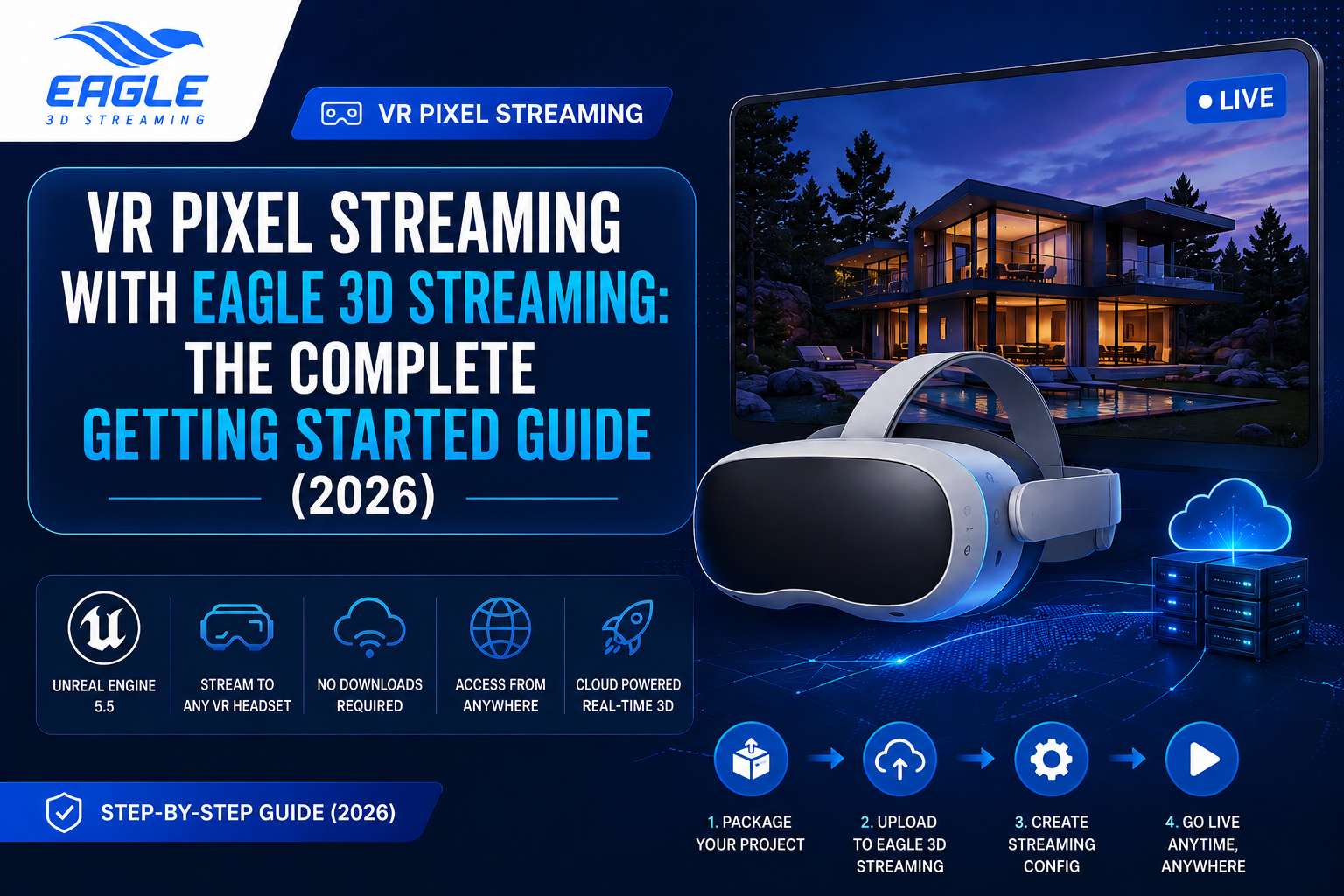
Once you have a working Linux build, the path through Eagle 3D Streaming follows the same general shape as a Windows build: create the build, upload it, set up a streaming config, and start the stream. The platform's documentation walks through each of those steps if you're doing this for the first time.
One thing worth knowing upfront, since it affects what to expect: Eagle 3D Streaming currently has higher load times for Linux builds specifically, not because Linux performs worse as a platform in general, but because Linux streaming infrastructure on E3DS isn't dedicated or fully optimized yet — demand for Linux builds has been lower than Windows, so the infra investment hasn't caught up. In practice that means when you open a Linux stream link, allocating the machine, starting it, and downloading your app onto it takes longer than the equivalent Windows flow.
If load time is a problem for your use case, the documentation points you to Support directly rather than a generic workaround, since this is an infrastructure-side limitation rather than something fixable from your build alone.
Also worth flagging if you're planning VR: Linux build streaming hasn't been tested in VR environments on the platform, so compatibility there is unverified rather than confirmed working.
What Genuinely Affects Pixel Streaming Performance, Linux or Otherwise
Setting aside the platform-vs-platform debate, the things that actually move the needle on Pixel Streaming performance are mostly the same regardless of OS:
GPU and encoder availability. Hardware-accelerated encoding (NVENC on NVIDIA hardware) matters far more than the host OS for stream quality and latency.
Scene complexity and resolution. Nanite, Lumen, and high-resolution textures all add encoding load, which shows up as latency or reduced frame rate under constrained GPU resources.
Network path between server and viewer. Geographic distance and network conditions affect glass-to-glass latency more than most server-side tuning does.
Concurrent session load on shared infrastructure. How many simultaneous streams a given GPU is serving affects per-session quality, which is why dedicated or enterprise-tier infrastructure behaves differently than shared resources.
FAQ
Is Nginx required for Unreal Engine Pixel Streaming? Not if you're using a managed platform like Eagle 3D Streaming, since it handles the signaling and web-serving layer for you. Nginx (often with the RTMP module) is relevant mainly in self-hosted Pixel Streaming setups.
Does Linux actually perform better than Windows for Pixel Streaming? It depends heavily on the specific infrastructure and use case, and most of the dramatic percentage claims circulating online for this aren't independently verifiable. On Eagle 3D Streaming specifically, Linux builds currently have higher load times due to infrastructure that isn't optimized for Linux yet, not Linux's underlying capabilities.
Where can I find official Unreal Engine Pixel Streaming documentation? Epic's Unreal Engine documentation site covers the Pixel Streaming plugin itself. For platform-specific setup on Eagle 3D Streaming, the Getting Started with Linux Pixel Streaming guide covers build creation, upload, and config.
Can I stream a Linux build in VR through Eagle 3D Streaming? This hasn't been tested on the platform, so VR compatibility for Linux builds is currently unverified rather than confirmed.
Why does my Linux stream take longer to load than my Windows stream? On Eagle 3D Streaming, Linux build streaming runs on infrastructure that isn't dedicated or fully optimized yet, since demand for Linux builds has historically been lower. The delay is on the infrastructure side, not something you can fix from your build configuration.
What's the difference between Pixel Streaming and Pixel Streaming 2? Pixel Streaming 2 is Epic's newer implementation introduced in recent Unreal Engine versions, with changes to the underlying plugin architecture. If you're starting a new project, check which version your target UE release ships with before assuming feature parity with older Pixel Streaming tutorials.
If you're working on a Linux build and want help getting it streaming, or your load times are higher than expected, reach out through Discord or support@eagle3dstreaming.com and we'll take a look.