From Colombian Architect to Unreal Engine Fellow: How Silvia Rueda Is Redefining Architectural Visualization
Published: April 23, 2026 · Episode 045 · Real-Time Talk with Eagle 3D Streaming
By: MD Rafshan Tashin · 8 min read
There's a moment in almost every architect's career where the tools they're using simply stop keeping up with their ideas. For Silvia Rueda — lead designer at Heatherwick Studio and head of its Immersive Media Cluster — that moment came while staring at a Photoshop file full of manually placed plants that looked nothing like the Revit landscape schedules she'd spent weeks building.
That frustration changed everything. Today, Silvia is one of the most interesting voices working at the intersection of Unreal Engine pixel streaming, real-time rendering, and architectural design — and her story is worth understanding in full.
Who Is Silvia Rueda?
Silvia is a London-based architect originally from Colombia, where she completed five years of formal architectural training — the kind that covers metal construction, wooden structures, and everything in between. When she moved to London for her master's degree in Interactive Architecture, she quickly realized the two worlds were almost nothing alike.
"When I landed in London, I was like — oh my God, what is architecture here? It's totally different. No structures, no wood, nothing," she explained on the podcast.
Rather than retreat into convention, she leaned into the unfamiliar. Her master's thesis involved 3D scanning strangers' faces to create bespoke wearable masks that used soft robotics and inflatable sensors to express the six core human emotions — think the eggman emoji reactions, but built in silicon and worn on your face.
The project was bizarre, brilliant, and entirely her own. It was also the clearest signal of how her career would unfold.
Why Landscape Design Became Her Focus at Heatherwick Studio
Heatherwick Studio is the kind of place where the scope of "design" is refreshingly wide. London buses. Floating parks. The Google Bay View campus in Silicon Valley. It was during her work on that last project — handling Revit schedules for landscape design on the Google headquarters — that Silvia ran into a wall that thousands of architects know well.
Visualizing landscape accurately in traditional tools is, as she put it, "basically impossible."
The standard workflow at the time: render something in V-Ray, screenshot from Rhino, drop it into Photoshop, place some plants manually. The result? A beautiful lie that bore no resemblance to what would actually grow on site.
"You'd be waiting in front of your computer an astronomical amount of time — and then you forget to turn on a light and have to re-render the whole thing," she said, with the weary laugh of someone who has definitely been there.
This is what pushed her toward real-time rendering — and eventually into becoming the studio's immersive media specialist. Check out our real-time rendering for architects.
How Twinmotion Changed Her Entire Approach to Visualization
Silvia's entry point into real-time rendering wasn't Unreal Engine — it was Twinmotion, which she describes as "the baby of Unreal." Since Epic Games acquired it, the tool has matured into something she now actively teaches to other designers at Heatherwick.
What makes Twinmotion particularly useful for landscape work? [INTERLINK: "Twinmotion vs Unreal Engine — Which Should Architects Use?" if you have one]
It's not just that it renders quickly. It's that it handles the variables that make landscape design so hard to communicate honestly:
- Time of day — a single slider changes the entire lighting and shadow environment
- Weather and seasons — you can make it snow, flip between seasons, choose evergreen species that retain leaves in winter
- Plant aging — another slider shows how the landscape looks at year one versus year five versus year ten
That last feature is something that rarely comes up in conversations about architectural visualization tools, but it matters enormously. Clients have always been sold on what a project looks like at its most photogenic — usually with fully flushed, mature planting that won't actually exist for a decade. Twinmotion lets designers show the honest version, and then make smarter species choices based on what the site will actually look like on opening day.
"It's super nice to show the client how the project will come at day one and then the difference between year five and year ten," Silvia explained. "So you can choose plants that are already a bit flush at year one."
The Unreal Engine Fellowship That Opened a New World
Alongside her work at Heatherwick, Silvia applied for — and was accepted into — the Unreal Fellowship, a competitive annual bootcamp run by Epic Games that accepts around 100 participants from a global pool. Her year focused on world building.
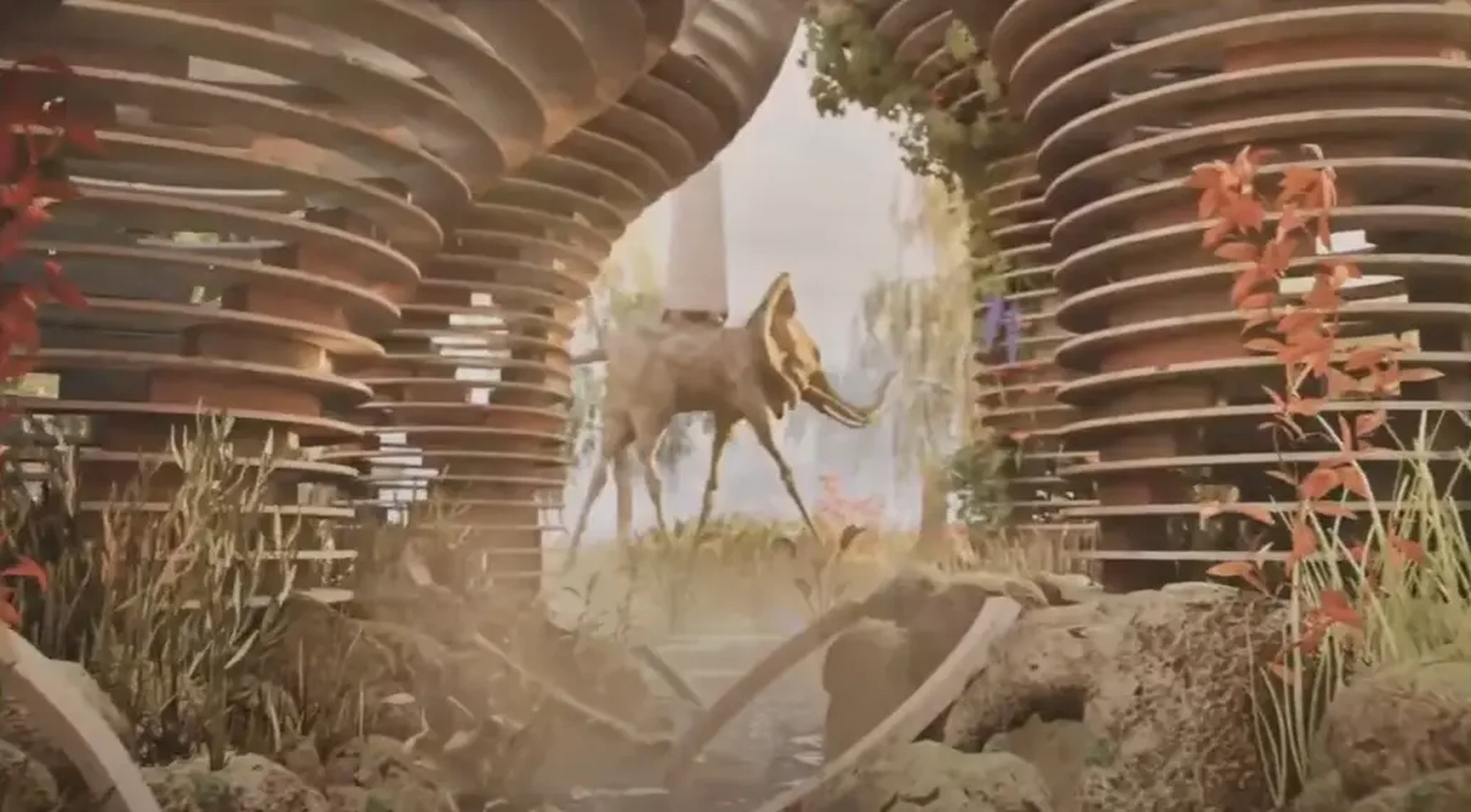
The format was deliberately chaotic. Each participant was given the same set of attributes but with randomized values — almost like rolling dice in Dungeons & Dragons. Same inputs, wildly different outputs. Silvia's assigned parameters: a swamp setting, surrealist style, concrete materials, golden hour lighting, fog, and — the one that threw her — a "plot twist of Animalia."
She leaned in hard. Inspired by a project she admired in Tokyo and the sculptural language of Bernard Tschumi's Parc de la Villette in Paris, she built a surrealist concrete landscape populated by a walking Dalí-style elephant, particle effects built with Unreal's Niagara system, and modular structures clustered at different heights across a foggy swamp environment.
It made the top 20 projects. One of the pieces of feedback she received came from a parent whose autistic child — who had been ignoring everything else during the showcase — stopped and stared at her scene.
"That's a huge compliment for an autistic child," she said. "Mic drop."
Nebula: A Burning Man Installation Built in Unreal Engine
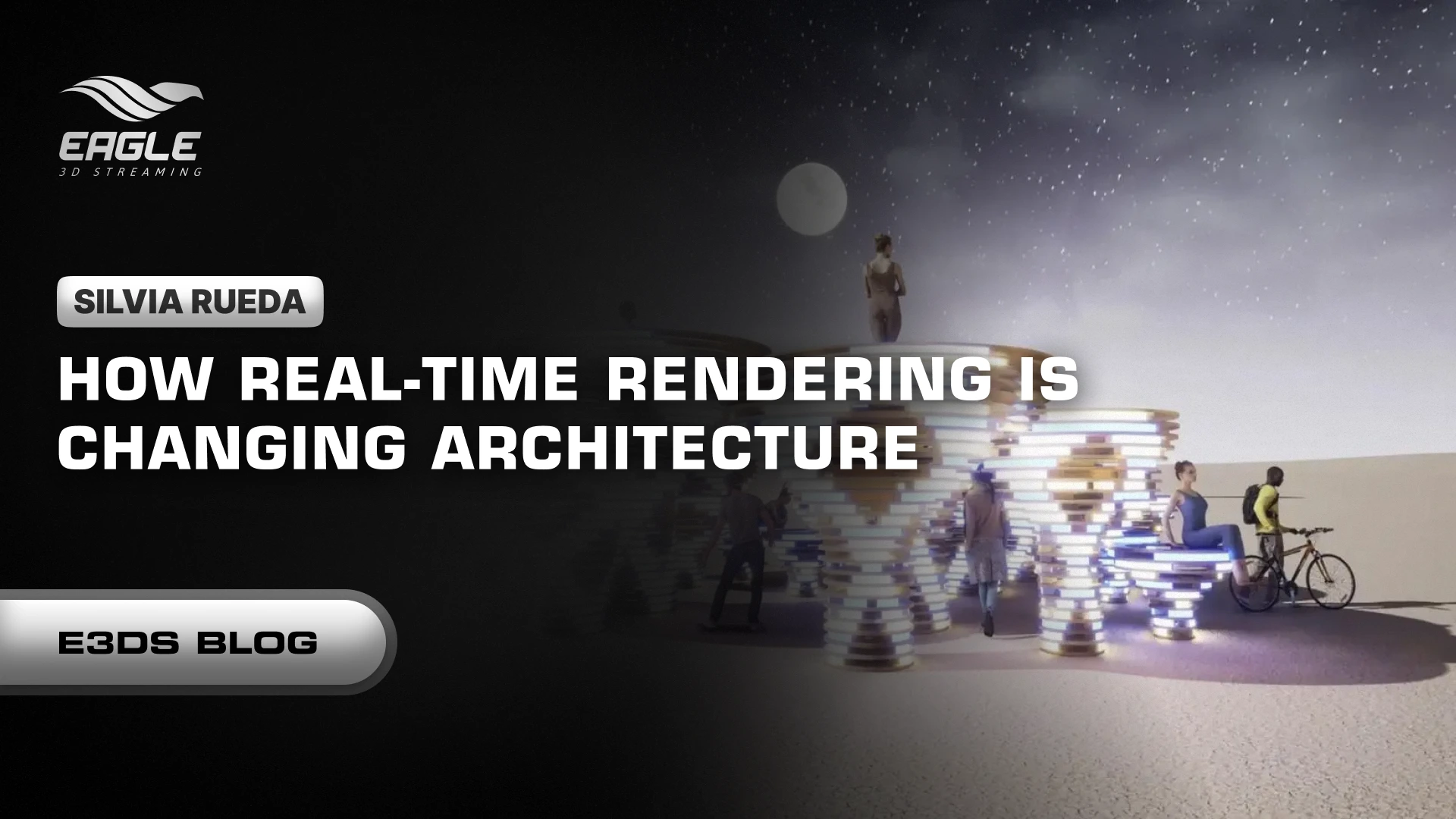
The most ambitious project Silvia discussed on the podcast is Nebula — a physical installation being brought to Burning Man, designed and developed in Unreal Engine, and representing Colombia at the event.
The Concept Behind the Project
The starting point was unexpected: a Colombian expression for loneliness. In Colombia, when you feel alone in a room, you say "soy un hongo" — "I am a mushroom." From that phrase, Silvia and her team began building a project that addresses something far larger than aesthetics.
The statistics she cited are sobering: 60% of people aged 18 to 34 in the UK report frequently feeling lonely. In the United States, nearly half the population reports experiencing loneliness regularly. Research suggests chronic loneliness is as damaging to health as smoking 15 cigarettes a day.
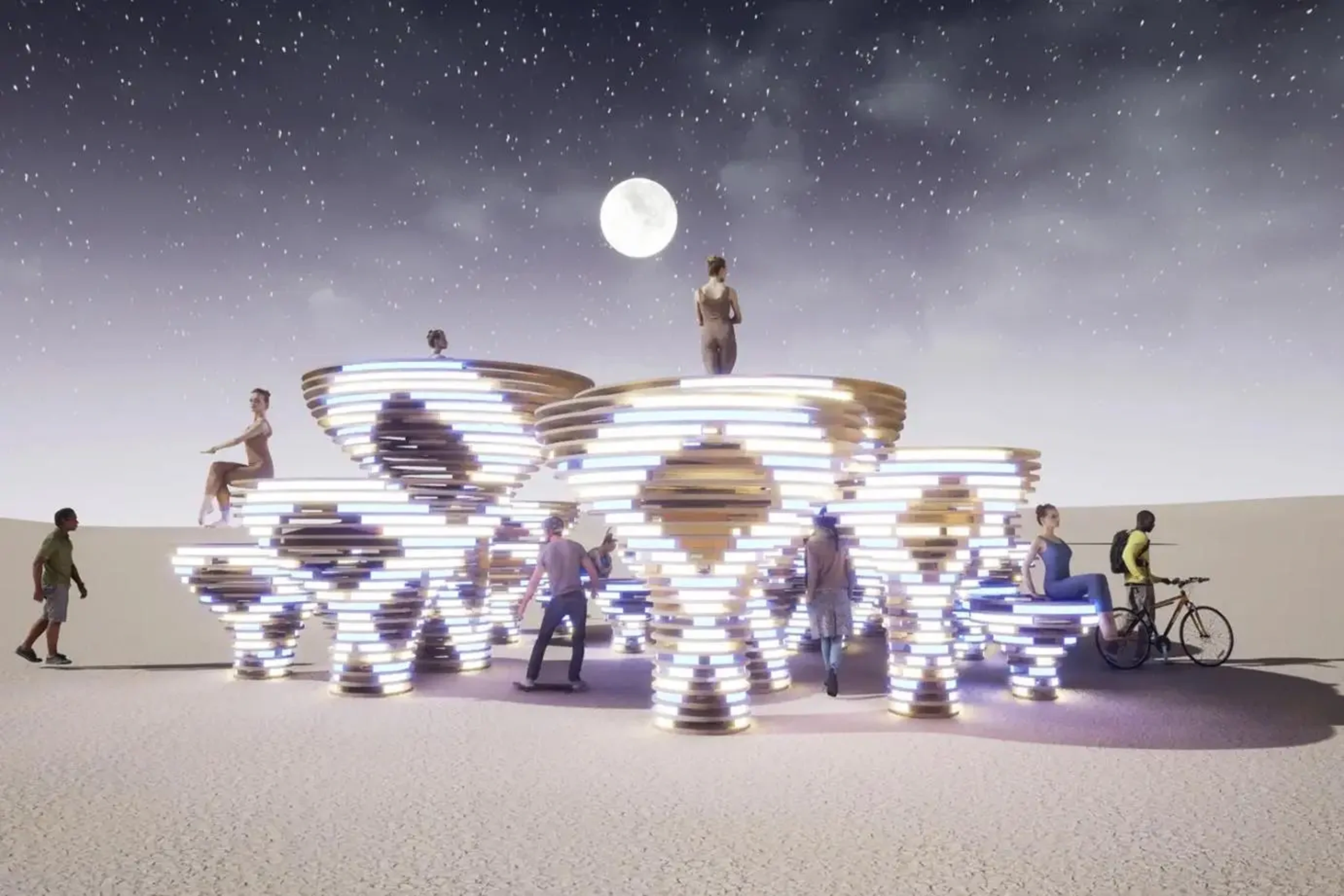
Nebula responds to that with architecture. The installation is built from modular plywood mushroom forms in four sizes (XL, L, M, and S), designed to shelter, to cluster, to lean on each other — structurally and symbolically. "We gave the mushroom company," as Silvia put it. "And then we made the mushrooms support each other."
The team earned an art grant from Burning Man, making them the first Colombian women-led team to represent Colombia at the event. But the grant covers only about 20% of the total project cost — which is why they're running online courses that let participants build their own Burning Man structure inside Unreal Engine while supporting the project financially.
How Unreal Engine and Pixel Streaming Made It Possible
Want to learn What is Pixel Streaming? Check Out here.
The full production stack for Nebula includes Rhino and Grasshopper for parametric structure and CNC file generation, Twinmotion for early visualization, and Unreal Engine for real-time lighting, dynamic materials, and DMX-controlled sensor integration.
The installation is designed to respond to its environment. Sensors in the structure detect sound — so if an art car rolls past with a bass-heavy sound system, the structure's lighting "dances" with it. If a yoga class is happening nearby, the lights shift to represent silence.
None of that is easy to communicate from a static rendering. That's where Unreal Engine pixel streaming came in. Eagle 3D Streaming's pixel streaming service
Working with Palatial (based in New York), the team built a pixel streaming version of the Nebula experience that anyone can access through a simple link — no headset, no powerful GPU, no technical knowledge required. Visitors to their fundraising events simply open a link on their phone and walk through the structure in real time.
"Not everybody is into technology. Sometimes you just need simplicity," Silvia said. "And pixel streaming is just a game changer for everybody."
The team has also used the same Unreal Engine model to explore what Nebula would look like in different environments — including the Colombian forests where they hope to eventually relocate the structure rather than burn it at the end of the festival.
What Real-Time Rendering Actually Changes for Architects
Check out this case study to understand how Eagle helps archviz studios:
Case Study: Bridging Real-World Design and Real-Time 3D with R3PLICA
It would be easy to frame this as a story about tools. But what Silvia's work really demonstrates is something more specific: real-time rendering changes the timing of when decisions get made.
In a V-Ray or traditional rendering workflow, design decisions get made before you can see the result. You commit to a plant species, a material, a lighting angle — and then you wait hours to find out if it worked. If it didn't, you change it and wait again.
In a real-time rendering environment — whether that's Twinmotion for accessible previsualization or Unreal Engine for full production visualization [INTERLINK: "Unreal Engine pixel streaming for architecture" service or blog page] — the feedback loop collapses. You see it now. You change it now. You can sit in a client meeting and drag a slider from morning to evening, from spring to winter, from year one to year ten, and the conversation shifts from "trust me, this will look good" to "what do you prefer — this or this?"
That's not just a workflow improvement. It's a different kind of professional relationship with the client.
Want to See Pixel Streaming in Action?
Silvia's project is one of dozens of real-world examples where Unreal Engine pixel streaming has replaced the old "send a render and pray" workflow. If you're an architect, developer, or design studio wondering what this could look like for your own projects, this is the right place to start.
Frequently Asked Questions
What is pixel streaming in Unreal Engine?
Pixel streaming is a technology built into Unreal Engine that lets you stream a real-time 3D experience directly to any browser or mobile device. The rendering happens on a powerful server, and the user receives a live video feed they can interact with — no download, no GPU, no headset needed. For architecture and design studios, it means clients can walk through a project on their phone as if they were inside a game.
How are architects using Unreal Engine for visualization?
Architects are using Unreal Engine to replace traditional rendering workflows that required hours of processing time for a single image. With Unreal Engine, designers can visualize a project in real time, adjust lighting, materials, and planting live in a client meeting, and share the result through a browser link using pixel streaming. Studios like Heatherwick are using it across landscape design, interiors, facades, and concept work.
What is Twinmotion and how does it differ from Unreal Engine?
Twinmotion is a real-time visualization tool owned by Epic Games — the same company behind Unreal Engine. It is designed to be beginner-friendly, with drag-and-drop assets, weather and season sliders, and a fast learning curve. Unreal Engine is more powerful and flexible but has a steeper learning curve. Many architecture teams use Twinmotion as an entry point and move into Unreal Engine for more complex, interactive, or custom projects.
What is the Nebula project at Burning Man?
Nebula is a physical architectural installation being brought to Burning Man by a Colombian women-led team, with Silvia Rueda as lead designer. The structure is made of modular plywood mushroom forms in four sizes and is designed around the theme of loneliness and community. It was developed entirely in Unreal Engine, uses DMX-controlled lighting that responds to sound sensors, and was shared with supporters using Unreal Engine pixel streaming.
Stay Connected with the Nebula Project
You can follow Silvia Rueda’s journey on Instagram at @srcuellar and connect with her on LinkedIn. The Nebula project itself is documented on Instagram at @understory_bm. If you’re heading to Burning Man, keep an eye out for Nebula on the Playa—it’s an experience worth seeing up close.
Conclusion
Silvia Rueda's career doesn't follow a straight line — and that's exactly what makes her work worth paying attention to. From soft robotics in London to landscape schedules in Silicon Valley to a mushroom-shaped installation in the Nevada desert, every step has been driven by the same instinct: find a better way to make ideas visible.
What Unreal Engine and pixel streaming gave her wasn't just faster renders. It gave her the ability to have honest conversations — with clients, with collaborators, with the public — about what a space will actually feel like. Not in six weeks after the render farm finishes. Right now, on a phone, in a browser, in a meeting.
That shift is quiet but significant. Architecture has always been about convincing people to believe in something that doesn't exist yet. Real-time rendering and pixel streaming don't change that challenge — they just make the case a lot easier to make.
If Nebula gets built in the desert this year, and eventually finds a home in a Colombian forest, it will have traveled from a Rhino file to a Grasshopper script to an Unreal Engine scene to a pixel streaming link — and finally into the physical world. That's a pipeline most studios are still figuring out. Silvia has already done it.
Get Involved
Connect with other creators, get support, and share your work on Discord.
🛠️ Need Help?
Our technical team understands Unreal Engine workflows and can help you troubleshoot or scale your deployment. Reach out at support@eagle3dstreaming.com
🚀 Ready to Upload Your Project?
Upload your Unreal project, configure your settings, and start streaming in minutes.