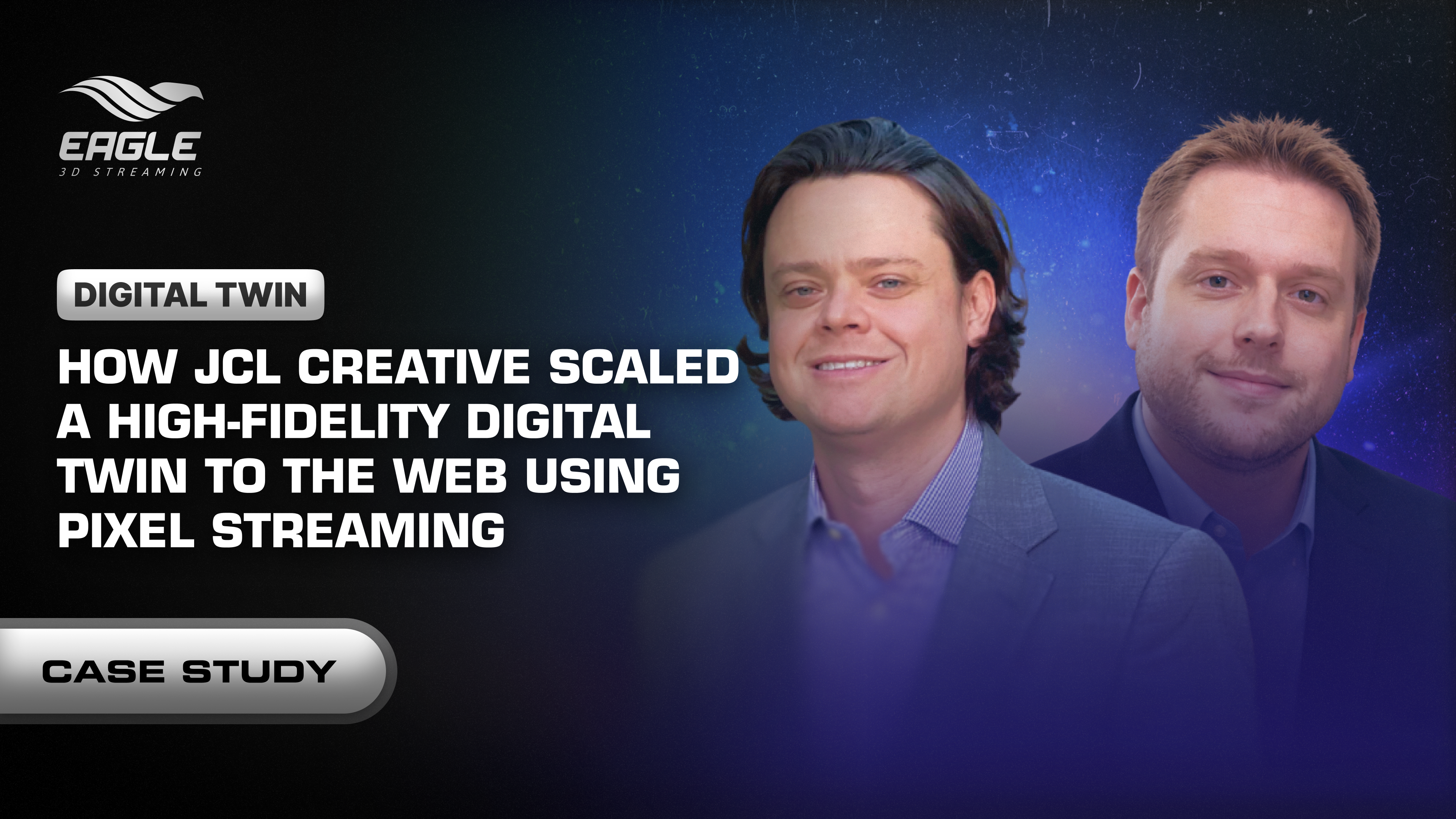
Podcast Episode: Real Time Talk: EP. 61 | Deep Dive into the NexTier Project with JCL Creative & Eagle 3D Streaming
Author: Rafshan Tashin
Read Time: 5 Minutes
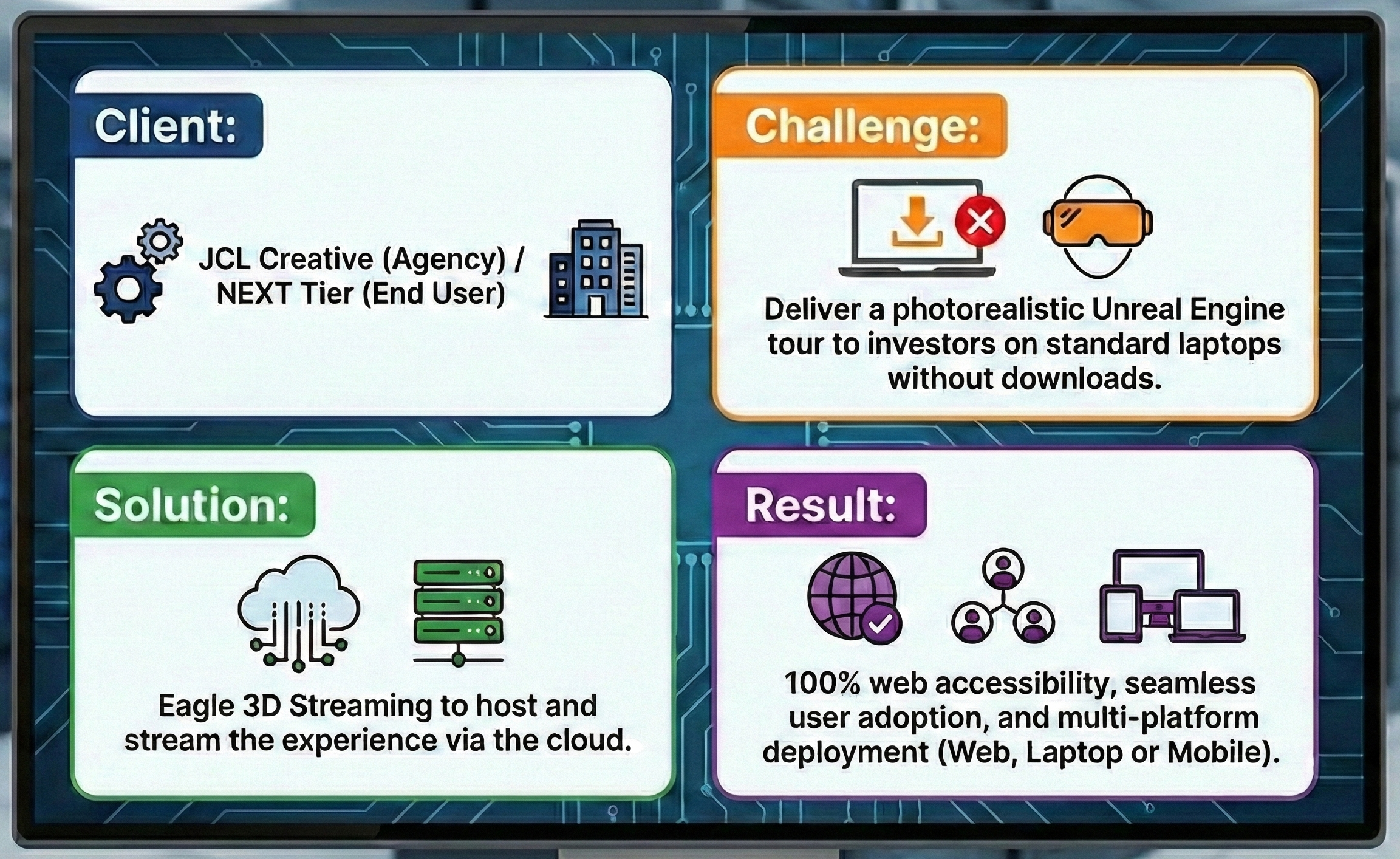
For energy sector investors, seeing is believing. When NEXT Tier wanted to showcase their advanced remote monitoring facility—the "Next Hub"—they didn't want a simple video walkthrough. They wanted a fully immersive, interactive Digital Twin that allowed investors to explore the facility as if they were there physically.
JCL Creative, led by Jonathan Labby, has been a cornerstone in the energy industry for over 25 years. Having partnered with Eagle 3D Streaming on numerous projects ranging from live events to animations, they knew that standard rendering methods wouldn't suffice for this level of interactivity.
"I think it's safe to say we have been partners in crime, in pretty much any type of digital media delivery experience." — Quentin Anderson, Eagle 3D Streaming
The team conducted an exhaustive site survey, taking hundreds of photos of carpet textures, desk corners, and fabric grains. The resulting Unreal Engine environment was so physically accurate that it fooled the client during the initial review.
"We were in a freeze frame of the environment, and they thought that we were actually in a photo of it. And [they] were just wondering, 'Hey, so when are we going to get to see it?' That was like... if you could ever give a compliment, that would be the compliment to give." — Jonathan Labby
While the visual fidelity was perfect, the delivery mechanism posed a massive problem. High-end Unreal Engine projects require expensive hardware, but the target audience—investors and stakeholders—would be accessing the tour on standard business laptops and tablets.
Furthermore, navigation was a concern. Most investors are not gamers; they are not familiar with standard video game mechanics like "W-A-S-D" keyboard controls.
Quentin Anderson noted the importance of knowing the end-user:
"You have to understand who your end user is and what their level of comfort is... We knew our end customer is not from the gaming industry... so we created a very simple interface for navigation."
If the application was too hard to use or required a complex download, the investment in high-fidelity graphics would be wasted.
To solve the hardware and usability bottlenecks, JCL Creative leveraged Eagle 3D's Pixel Streaming infrastructure. This moved the processing power from the user's device to the cloud.
Eagle 3D hosted the heavy Unreal Engine application on enterprise-grade cloud GPUs, effectively decoupling the visual quality from the end-user's hardware. Instead of forcing investors to download a multi-gigabyte executable—which would be impossible on standard business laptops or corporate tablets—the application ran entirely on Eagle 3D's servers.
The visual output was encoded and streamed as a high-definition, low-latency video feed directly to the browser. This meant that any investor could click a single URL and instantly step into the high-fidelity "Next Hub" environment without installing plugins, managing software updates, or waiting for large assets to load.
Instead of traditional game controls, the team implemented a "guided experience" using web-based overlays. Users could navigate via simple forward/back buttons. Crucially, the information panels were not rendered in 3D but were HTML iFrames that popped up over the stream.
This allowed the text and data to be crisp, readable, and interactive—just like a standard webpage—while the 3D background remained immersive.
Jonathan Labby emphasized that this hybrid simplicity was key:
"The iFrames that popped up... that had the information on it... that was pivotal for it. It was one thing to navigate, but having these pop-up windows... was very familiar. It's very web-based, very typical for what the end user is used to."
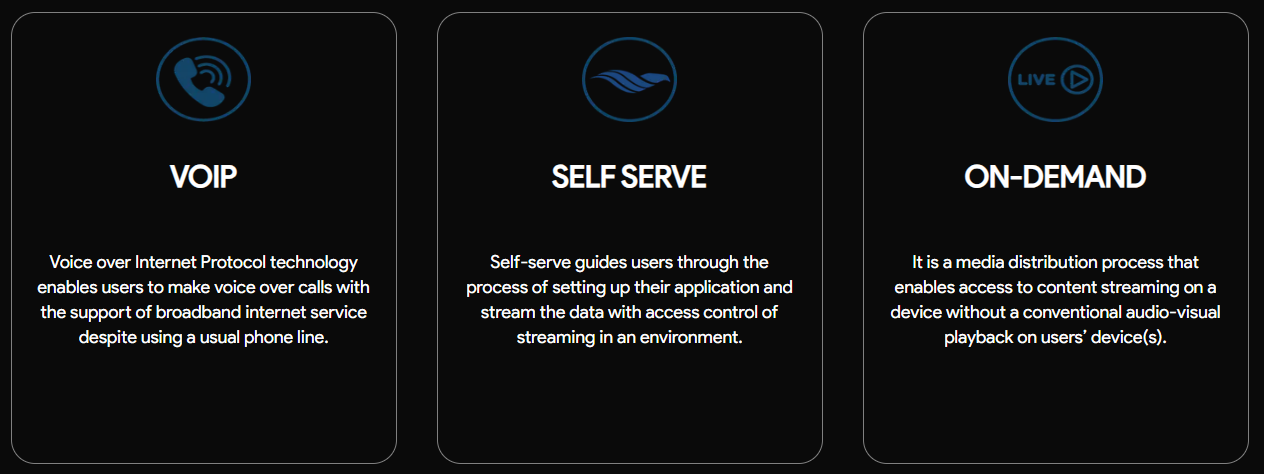
The deployment was a resounding success, but the value didn't stop at the web. Because the project was built on a flexible Unreal Engine foundation and supported by Eagle 3D's versatility, JCL Creative was able to deploy the same asset across three distinct environments:
This approach allowed NEXT Tier to get maximum mileage out of a single creative investment.
"One of the nice things about knowing these different technologies is... knowing how you can use that technology to build upon it so that [the client] feels like they're getting the most value out of it." — Jonathan Labby
If you are looking to leverage immersive technology for your business, here are three ways to move forward with Eagle 3D Streaming:
If you want to understand the technology better, connect with other developers, or contact us directly, join our Discord server:
If you know about Pixel Streaming but want to understand how to optimize your project for the web, try our free guide:
Get the Free Pixel Streaming Guide
If you have a project ready and want to stream it to the world immediately, upload your project by signing up here:
Share the post
Blogs


The Ultimate Bridge: Why UE Devs and Visualization Agencies Need the Eagle 3D Features Plugin
Unlock the full potential of Unreal Engine Pixel Streaming with the Eagle 3D Features Plugin. Simplify browser-to-engine communication with ready-to-use Blueprint nodes f...
A Better Way to Access Unreal Editor Remotely: Ending the Pixel Streaming Complexity
Discover how the E3DS Remote Control Plugin simplifies remote Unreal Editor access for debugging, training, and team collaboration without complex setup....
Case Study: Bridging Real-World Design and Real-Time 3D With R3PLICA
Discover how R3PLICA uses Unreal Engine and Eagle 3D Streaming to deliver real-time 3D experiences and manufacturer-accurate design assets to creators worldwide....
Case Study: Democratizing High-Fidelity 3D Visualization With Spine3D
Discover how Spine3D uses Unreal Engine and Eagle 3D Streaming to deliver high-fidelity 3D visualization and VR experiences instantly through any web browser....